

Myanmar Jolted by 4.7 Magnitude Earthquake, Tremors Felt Across Manipur, Nagaland and Assam

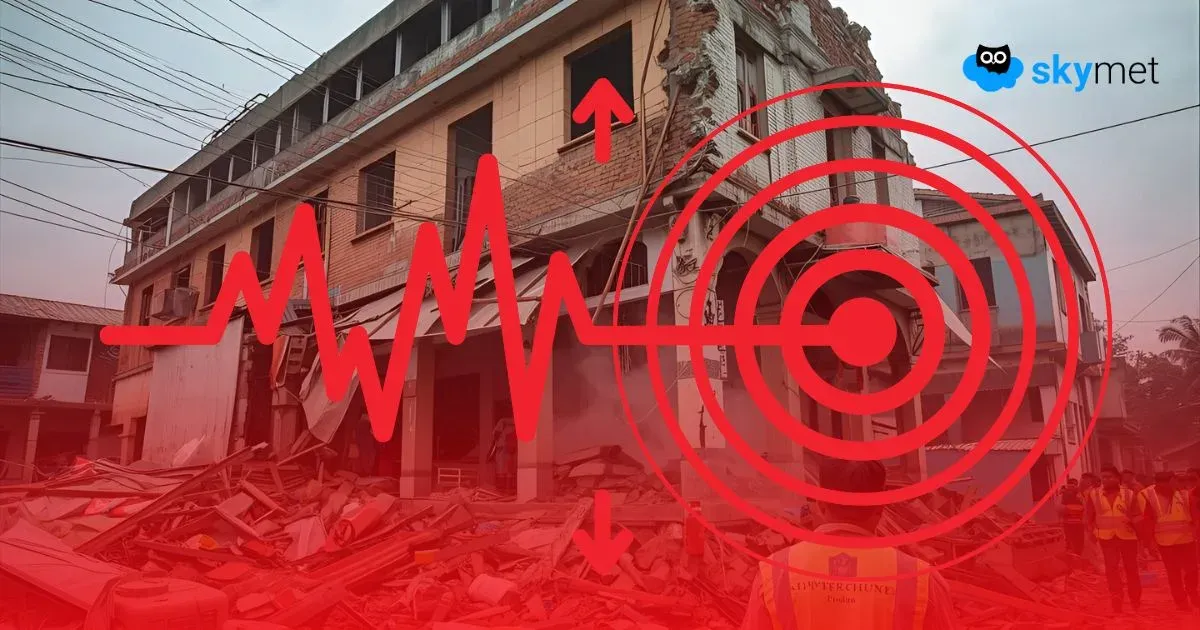
Image: AI-Skymet
A moderate earthquake of magnitude 4.7 struck Myanmar early Tuesday morning, sending mild tremors across parts of Manipur, Nagaland, and Assam in Northeast India.
According to the National Center for Seismology (NCS), the quake occurred at 06:10:01 IST on September 30 at a depth of 15 km. The epicenter was located at latitude 24.73°N and longitude 94.63°E—about 155 km south-southeast of Wokha (Nagaland), 159 km southeast of Dimapur, and 193 km northeast of Champhai (Mizoram).
A Week of Seismic Activity in the Region
Advertisement
Advertisement
This latest tremor follows two earlier quakes in Myanmar on September 28.
- The first, magnitude 4.0, struck at 06:25 IST at a shallow depth of 10 km.
- Hours later, a second quake of magnitude 3.2 was recorded at 13:48 IST, originating from a depth of 60 km.
The tremors are part of a seismically active pattern in the region, which lies at the intersection of four tectonic plates—Indian, Eurasian, Sunda, and Burma—making Myanmar highly vulnerable to moderate and large earthquakes, and even tsunami hazards along its coastline.
Why Shallow Earthquakes Can Be Risky
Shallow earthquakes, typically those occurring at depths less than 70 km, tend to be more damaging than deeper ones.
Because seismic waves have less distance to travel to the surface, ground shaking is more intense, increasing the risk of damage to buildings and infrastructure and raising casualty potential.
The September 30 quake, at just 15 km depth, falls into this category, though its moderate magnitude limited its impact.
Myanmar’s Seismic History: A March 2025 Reminder
Earlier this year, on March 28, 2025, central Myanmar was struck by two massive quakes of magnitude 7.7 and 6.4. The twin shocks caused widespread devastation and triggered public health emergencies. The World Health Organisation (WHO) warned of rising risks of tuberculosis (TB), HIV, and vector- and water-borne diseases among displaced populations.
Advertisement
Such events underline the persistent seismic threat in Myanmar and surrounding regions.
Neighbourhood Also Feels the Shakes
Myanmar’s quake came just hours after a magnitude 3.4 earthquake hit Satara, Maharashtra, shortly past midnight on September 30. Another 3.3-magnitude tremor was recorded in Tibet early morning.
Meanwhile, Bangladesh experienced a magnitude 3.5 quake on September 27, only 89 km from Kolkata, with tremors felt in parts of West Bengal.
Context That Endures
While moderate earthquakes like Myanmar’s 4.7-magnitude event rarely cause major destruction, they’re critical reminders of the region’s tectonic volatility. Regular seismic activity across Myanmar, India’s Northeast, and neighbouring Bangladesh underlines the need for preparedness, resilient infrastructure, and public awareness in these vulnerable zones.


