

Autumnal Equinox 2025 Brings 'Fall' To The Northern Hemisphere Today-22nd September

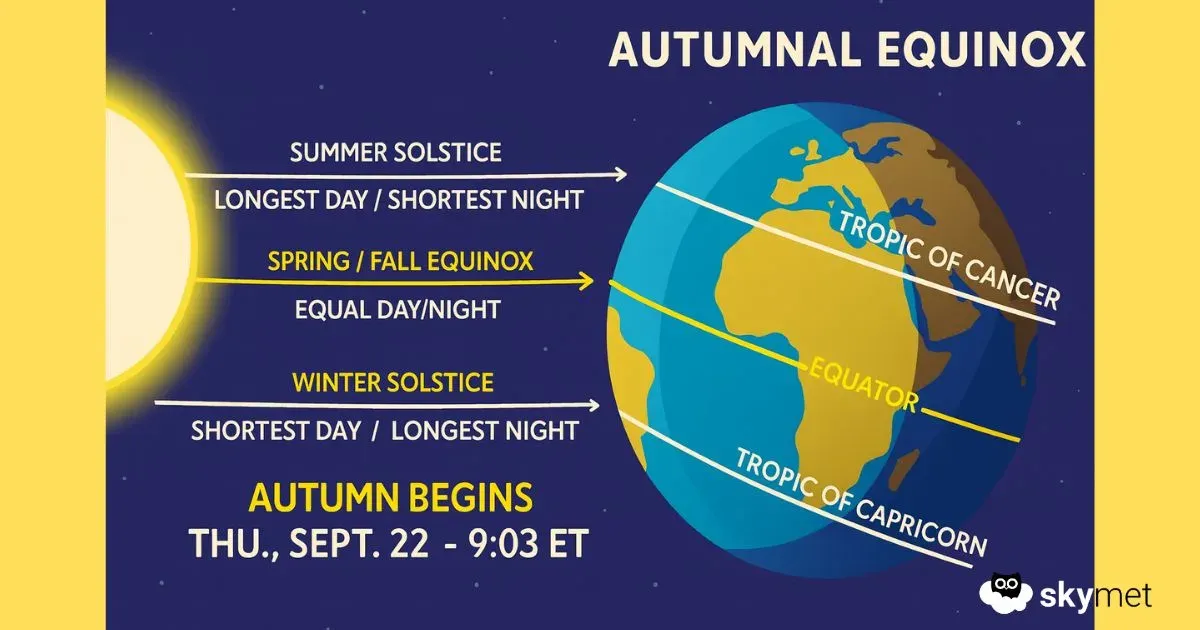
Autumnal Equinox, Image: AI-Skymet
A solar equinox is a moment in time when the Sun appears directly above the equator, rather than to its north or south. On the day of the equinox, the Sun appears to rise directly East and set directly West. This occurs twice a year, around 20th March and 23rd September. In September, the Sun crosses the equator from North to South, and the other way round in March. On 20th March, also called the Vernal Equinox or Spring Equinox in the Northern Hemisphere, it marks the beginning of astronomical spring. This is also called the ‘northward’ equinox, as the Sun appears to cross the celestial equator moving northward from the Southern Hemisphere.
Advertisement
Equinoxes are not day-long events and they occur at the moment the Sun crosses the celestial equator, the imaginary line in the sky above Earth’s equator. In the Northern Hemisphere, astronomically, the September equinox is the ‘Fall’ equinox, marking the end of summer and beginning of ‘Fall’ (Autumn). The ‘Fall’ season ends on the December Solstice, when astronomical winter begins.
Advertisement
The equinox does not mean that day and night are equal, which happens only on the Solstice day. The Full Moon closest to the September equinox is called the ‘Harvest Moon’. It is astronomically special because at Full Moon, the time from one moonrise to the next becomes shorter, albeit with small margins. It is because of the low angle of the Moon’s orbit around the Earth. Normally, there is about a 50-minute delay from one day to the next. Moonrise at any place is closer to the sunset time (not exactly the same) on the ‘Full Moon’ day. Timings of the equinox will vary all over the globe, depending upon the location (latitude/longitude). The countdown for the national capital has started. The equinox time for Delhi is Monday, 22nd September, 23:49 IST.


