

Nino Index Breach Threshold Mark: La Nina Likely During Fall Of Year


Image Courtesy: AI-Skymet
The Pacific Ocean has been transitioning between ENSO events during the last two years. After the triple-dip La Niña between 2020–22, El Niño conditions appeared for nearly 12 months between Apr–May–Jun 2023 and Mar–Apr–May 2024. ENSO-neutral followed during the monsoon 2024. Close on the heels, a brief stint of La Niña surfaced between Dec 2024 and Feb 2025. This was the shortest span of La Niña on record since the time of reliable repositories in the data bank. The Climate Prediction Center (CPC), governed by the National Center for Environmental Prediction (NCEP), maintains the ENSO Alert System Status as ‘La Niña Watch’. It means La Niña is expected to evolve in the next few months. ENSO-neutral persisting throughout the monsoon season is likely to make way for La Niña during the fall of this year or early winter 2025–26. Once again, the La Niña season is expected to be short and sweet. The equatorial Pacific may turn neutral yet again during the spring of the Northern Hemisphere (2026) and extend well into monsoon 2026.
Advertisement
Latest data shared by the World Meteorological Organization (WMO) indicates a 55% likelihood that sea surface temperatures in the equatorial Pacific will cool to La Niña levels from September to November. For Oct–Dec 2025 the probability of La Niña conditions slightly increases to about 60%. Their latest global update indicates that for Sep–Nov, temperatures are expected to be above normal in much of the Northern Hemisphere and large parts of the Southern Hemisphere. Rainfall predictions are expected to be similar to those typically observed during a moderate La Niña, the WMO assessment noted.
Advertisement
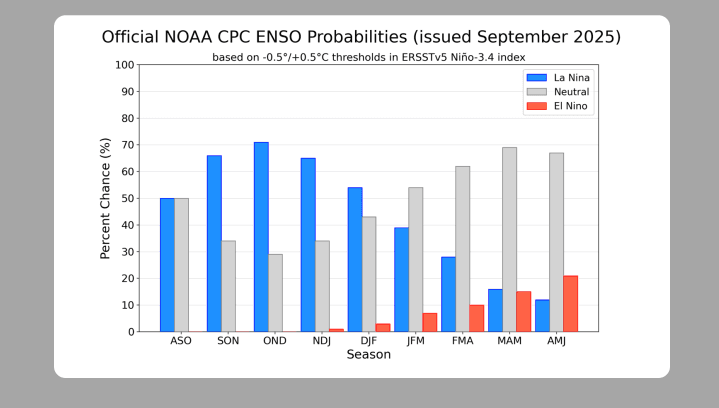
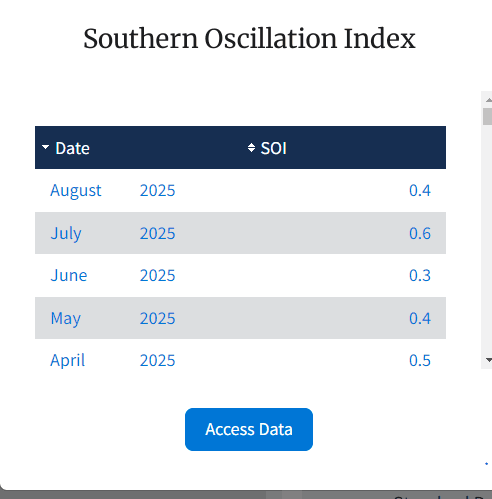
ENSO: In the recent WMO report, as of August 2025, ocean and atmosphere indicators continue to reflect ENSO-neutral conditions, which have persisted since Mar 2025, with SST anomalies remaining near average across the equatorial Pacific. However, these conditions are likely to gradually make way for La Niña to emerge in the coming months, potentially starting in Sep 2025. The equatorial Southern Oscillation Index (SOI) for August 2025 was 0.4, falling within the ENSO-neutral range. The low-level wind anomalies are also aligned with the neutral conditions in the east-central and eastern Pacific. Below-average surface temperatures have intensified over these parts of the ocean. Should these cooler anomalies strengthen further in conjunction with enhanced trade winds, it may hasten the onset of La Niña conditions, even earlier than expected.
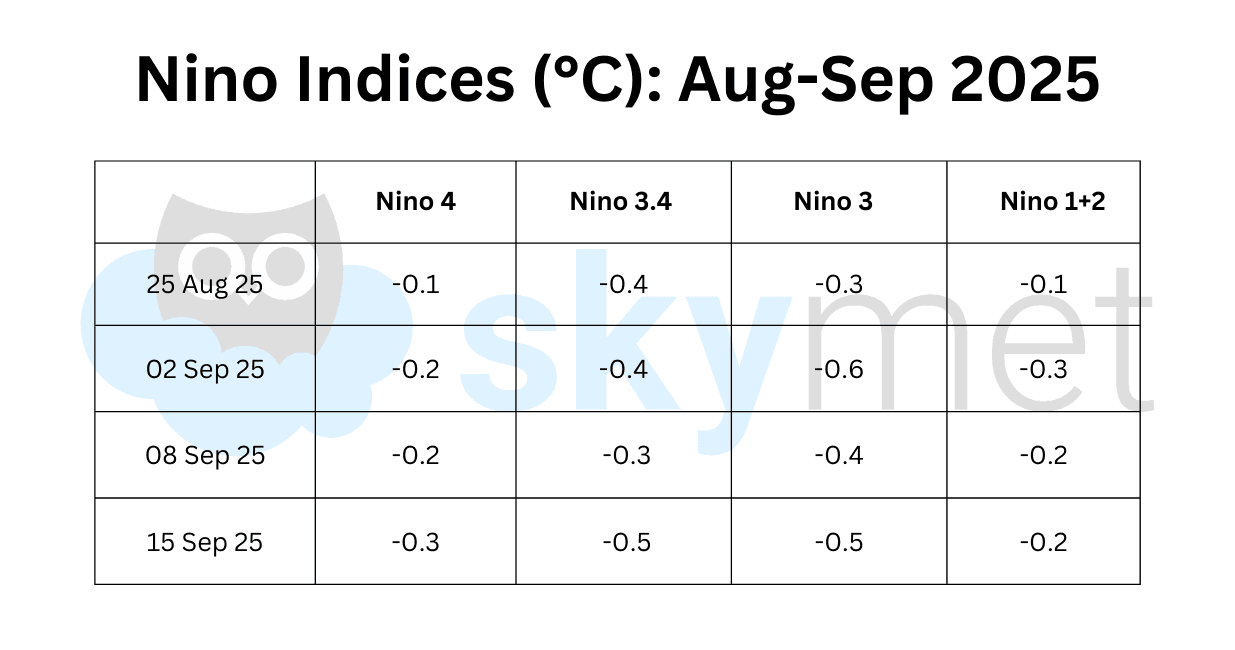
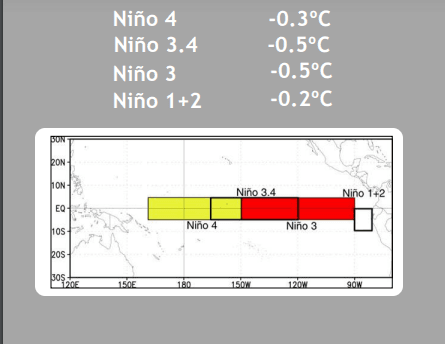
All the Niño indices are in decline across the equatorial Pacific. Niño 3.4, the marker index for ONI, has breached the threshold mark of –0.5°C for the first time since the cessation of La Niña in winters this year. The negative anomaly enhances the chance and may expedite the start of La Niña. Should such anomalies sustain, La Niña may show up by the fall of this year. The BoM model predicts further cooling of the tropical Pacific, potentially reaching La Niña level during the fall, extending to early winters 2026, and returning to neutral during boreal summer.
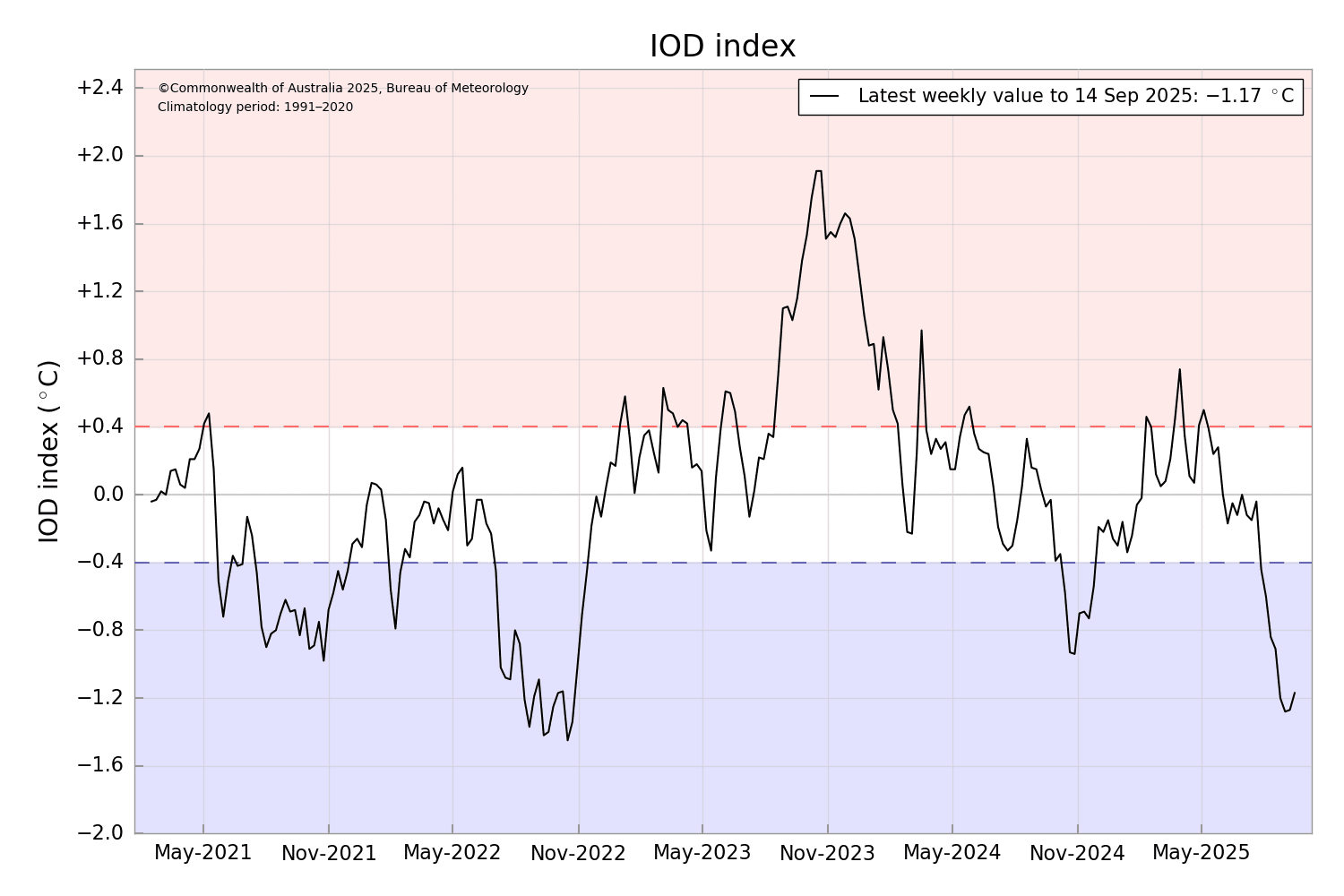
IOD: The SST analysis for the week ending 14 Sep 2025 shows warmer-than-average waters across much of the Australia region. The equatorial Indian Ocean on the western side is cooling faster than normal. The Indian Ocean Dipole has now met the negative IOD threshold (≤ –0.4°C) for eight consecutive weeks. This suffices to be classified as a negative IOD event. The latest IOD index value for the week ending 14 Sep 2025 was –1.17°C. It is pertinent to note that the index has been lower than –1°C for the last four consecutive weeks. The BoM model predicts the negative IOD event to continue during the northeast monsoon season and return to neutral in early winters next year. This is consistent with other models and the typical IOD cycle.
Advertisement
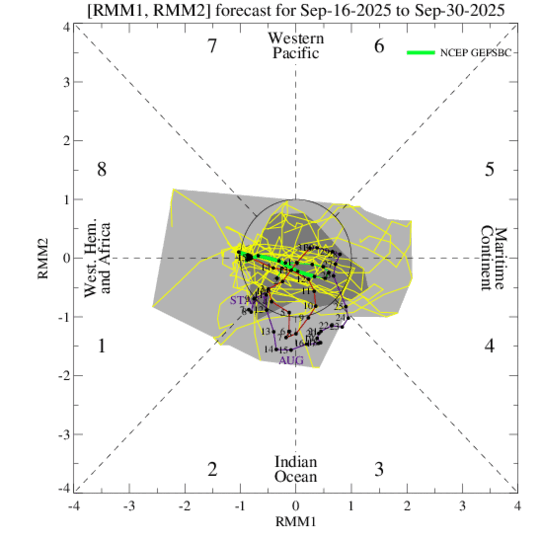
MJO: A weak MJO is propagating eastward and is positioned over the Western Hemisphere and Africa in Phases 8 and 1. It is likely to make a loop in the inner circle, keeping minimal amplitude. The exact location of MJO could be difficult to discern during the last week of September. Otherwise, the fading circulation may be practically inconsequential for any monsoon activity in the Indian Seas.
IOD and ENSO are both in a transitioning phase. While the negative IOD event may formally be announced anytime soon, ENSO will enter a cool phase during the post-monsoon season of the Indian subcontinent. Negative IOD and La Niña together are not very commonly seen. However, both are likely to have a short stint and respectively turn neutral during the early spring of next year.


