Japan’s Megaquake Alert: Is India at Risk?

Image: Skymet
KEY TAKEAWAYS
- Japan issued its first-ever megaquake advisory after an M7.5 quake off Aomori’s coast.
- The alert signals a slightly higher short-term chance of an M8+ quake, though the probability remains low.
- Japan’s tectonic setting makes the region susceptible to major megathrust earthquakes.
- India faces no elevated risk, as Japan-Trench tsunamis remain confined to the Pacific basin.
Advertisement
Japan just issued an unprecedented “megaquake advisory” after a powerful magnitude-7.5 earthquake struck off Aomori’s Pacific coast late Monday night. The quake, centred about 54 km deep, cracked roads, damaged buildings, triggered small tsunamis of 60–70 cm and injured more than 30 people, forcing nearly 90,000 residents to evacuate. Though the damage was limited, the shaking was felt as far as Tokyo, nearly 550 km away, and it immediately raised concern among scientists because of where it occurred: right along the Japan and Kuril Trenches, two of the most dangerous subduction zones on Earth.
Advertisement
Why the Advisory Was Issued
Under protocols introduced in 2022, the Japan Meteorological Agency issues a “megaquake advisory” when a magnitude-7 or higher tremor strikes inside or very close to the source zones of past giant earthquakes. This is the first time such an alert has been applied to the Hokkaido–Sanriku sector. It signals that, for the next week, the chance of a magnitude-8 or larger quake is temporarily higher than normal — around one per cent, still low in absolute terms but significant enough for authorities to push residents to stay alert, refresh evacuation plans and prepare emergency supplies. The advisory is not a forecast; rather, it is a precaution triggered because large megathrust earthquakes can sometimes follow strong foreshocks. In 2011, the catastrophic magnitude-9.0 Tohoku earthquake was preceded by a magnitude-7.3 tremor just two days earlier, in almost the same segment of the Japan Trench.
Japan’s Tectonic Vulnerability
Japan’s north is especially vulnerable because the Pacific Plate is diving beneath the North American and Okhotsk plates along the Japan and Chishima Trenches, locking huge amounts of strain that occasionally release in devastating megathrust events. Government estimates warn that a worst-case Hokkaido–Sanriku offshore quake could generate a tsunami as high as 30 metres (98 feet), kill up to 1,99,000 people, destroy more than two lakh buildings and cause nearly 31 trillion yen in economic losses. If such an event occurs in winter, tens of thousands could suffer hypothermia. The current advisory covers 182 municipalities from Hokkaido to Chiba, one of the widest geographical alerts Japan has issued in recent years.
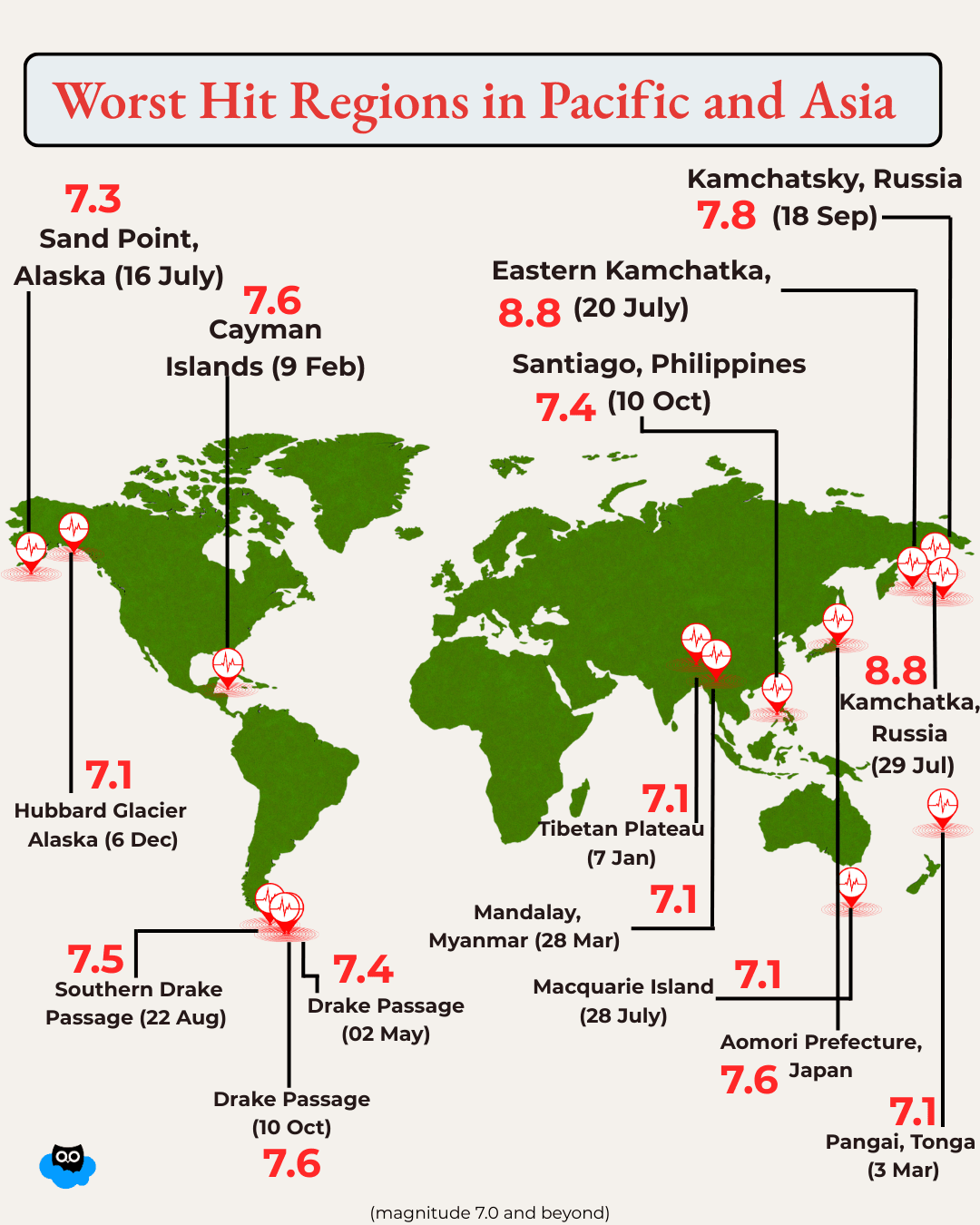
Should India Be Worried?
Despite the dramatic headlines, the implications for India remain limited. A megaquake off Japan would mainly affect the northwest Pacific — Japan, Russia’s Far East and possibly Alaska’s Aleutian arc. Tsunami energy from Japan-Trench events tends to stay focused within the Pacific basin. India’s coastline is far more vulnerable to giant quakes along the Sunda Trench near Sumatra and, to a lesser extent, sources in the Arabian Sea. India’s worst tsunami in history, in 2004, was triggered by a magnitude-9.1 quake off Sumatra, not by a Pacific event.
Conclusion
Advertisement
So while Japan’s advisory highlights the shared tectonic risks of a subduction-zone planet and underscores the value of strong early-warning systems, it does not indicate any elevated earthquake or tsunami threat for India in the coming days.