Why Did Hayli Gubbi Volcano Erupt After 12,000 Years? What to Expect Next

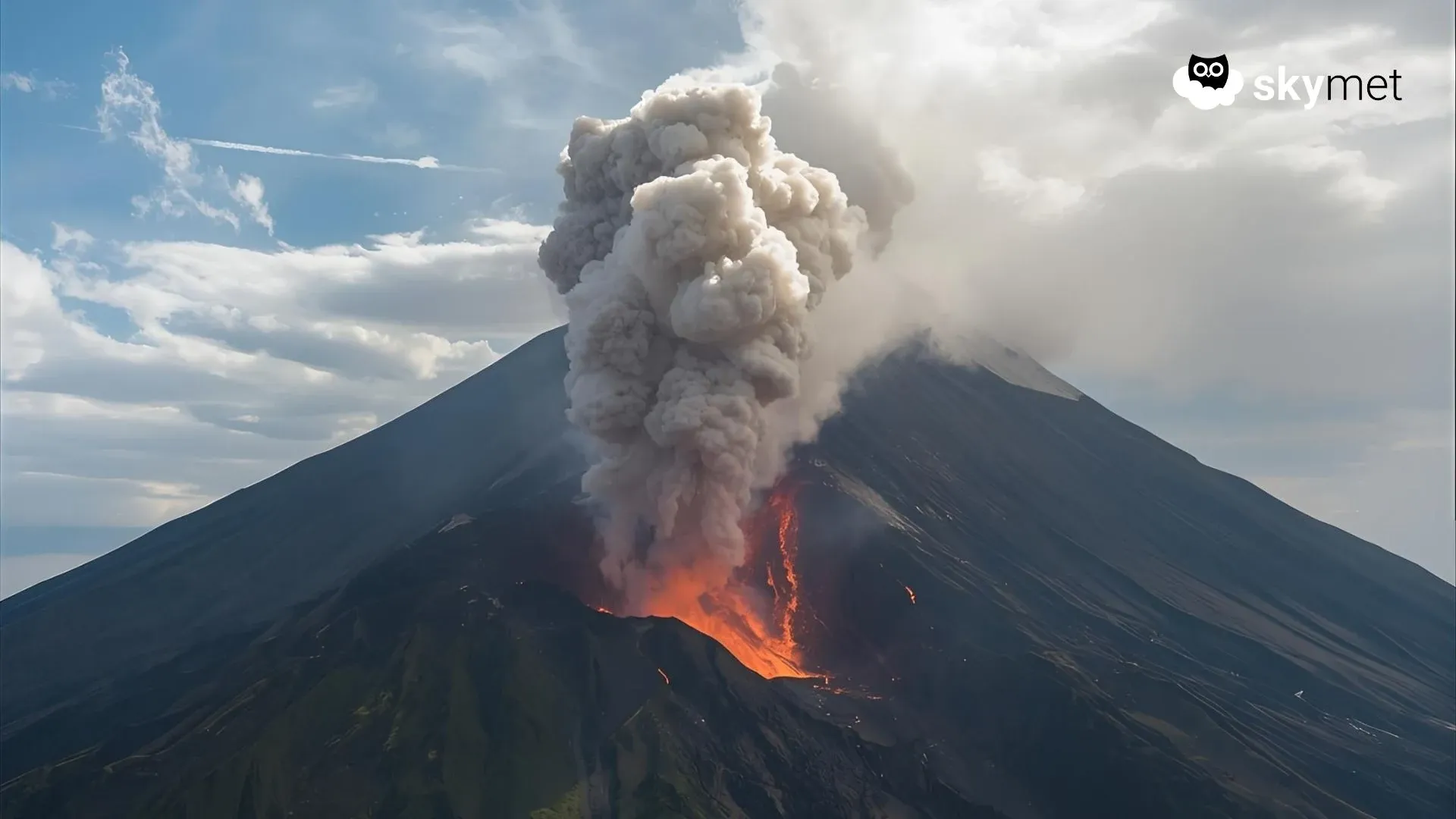
Hayli Gubbi Volcano Eruption, Image: AI-Skymet
KEY TAKEAWAYS
- Hayli Gubbi erupted after nearly 12,000 years, sending ash toward India.
- The ash plume travelled at high altitudes over western and northern states.
- Health risks remain limited but sensitive groups should remain cautious.
- The plume is expected to exit India by this evening.
Advertisement
A rare geological event has captured global attention after Ethiopia’s Hayli Gubbi volcano erupted for the first time in nearly 12,000 years, releasing a massive cloud of volcanic ash that travelled across the Red Sea, swept over Yemen and Oman, and eventually drifted into Indian skies.
Advertisement
The plume entered India late Monday night, moving at high altitudes across Gujarat, Rajasthan, Delhi-NCR, Haryana, Punjab and parts of Maharashtra.
The eruption, which occurred in Ethiopia’s Afar region, is being closely monitored by meteorological agencies and aviation authorities due to its wide-reaching atmospheric effects.
Indian airlines were among the first to respond to the situation. Akasa Air cancelled flights to Jeddah, Kuwait and Abu Dhabi, while KLM suspended its Amsterdam–Delhi service. IndiGo also issued an advisory after adjusting some routes. The DGCA has directed all airlines to avoid ash-affected airspace and report any engine anomalies or suspected ash encounters. High-level satellite imagery shows the ash cloud sitting between 15,000 and 25,000 feet, with some pockets rising up to 45,000 feet—well above the air we breathe at ground level.
Why the Hayli Gubbi Volcano Erupted After 12,000 Years?
The eruption is linked to the Afar Rift, one of the most active tectonic zones in the world, where the African and Arabian plates are slowly pulling apart. This process allows magma from deep beneath the Earth’s crust to rise upward.
Over thousands of years, that magma likely accumulated, increasing pressure until the rock above could no longer contain it. A small earthquake recorded shortly before the eruption suggests that the rising magma forced its way toward the surface, triggering the sudden event on November 23. Since the region is extremely remote, scientists are relying primarily on satellite data to study this rare eruption.
How Much Will India Be Affected?
For now, the primary impact on India remains in the upper atmosphere, not at ground level. Our experts explain that the ash plume is travelling far above the mixing layer of Delhi’s air, meaning only a minimal amount—if any—is expected to descend to breathing height.
Delhi’s poor air quality today is largely due to existing local pollution rather than volcanic ash. However, sensitive individuals could still experience additional irritation if fine particles mix downward, especially in areas already struggling with severe AQI levels.
The visual effect of the ash may linger temporarily, with hazier skies or diffused sunlight in some regions. Flights may continue to face last-minute adjustments as long as the plume remains in Indian airspace.
Advertisement
According to the latest forecasts, the ash cloud is expected to move out of India by around 7:30 pm today, drifting northeast toward China.
How May Volcanic Eruptions Impact Daily Life?
Volcanic ash can disrupt several essential systems even thousands of kilometres away from the eruption site. High-altitude ash can interfere with aviation routes, satellite communication, and navigation systems.
On the ground, if ash were to descend, it could coat buildings, contaminate water sources, and temporarily affect agriculture by settling on leaves. In this case, India is experiencing only the atmospheric influence of a distant eruption.
Health Effects of Volcanic Ash: What People Should Know
Volcanic ash is made up of fine particles of rock, minerals and glass, often coated with acidic compounds and mixed with gases such as sulphur dioxide. These particles behave much like PM2.5 pollution and can irritate the eyes, throat and lungs. People with asthma, COPD, bronchitis and other respiratory conditions are more likely to feel discomfort.
Short-term exposure can cause coughing, sore throat, headaches, dizziness and breathing difficulty. Skin dryness and eye irritation are also common when ash levels are significant.
While most of the ash over India is at high altitudes, residents—especially in Delhi NCR—should remain cautious since the region already faces heavy pollution loads.
Using N95 masks outdoors, keeping windows shut, avoiding strenuous outdoor activity, and maintaining clean indoor air can help minimise risks. Sensitive groups, including children, older adults, pregnant women and those with chronic lung or heart conditions, should be extra careful.
What to Expect in the Coming Hours and Days?
The ash plume is moving quickly and is projected to exit Indian skies this evening. No long-term impact on surface air quality is expected.
Air travel may continue to see temporary diversions until the plume clears completely. For most residents, the situation requires awareness rather than alarm. Meteorological agencies will continue monitoring satellite imagery and dispersion models to track any shifts in the plume’s movement.
The Hayli Gubbi eruption is a reminder that distant natural events can interact with existing environmental conditions back home. With appropriate precautions and steady monitoring, the influence of this ash cloud on India is expected to remain limited, and conditions should gradually normalise as the plume moves eastward.