La Nina Takes Baby Steps: IOD Remains Neutral


Key Takeaways
- Equatorial Pacific conditions and SOI continue to support a weak La Niña signal.
- ONI has crossed the La Niña threshold, but Niño indices show limited reinforcement.
- IOD is trending towards neutral, consistent with seasonal climatology.
- La Niña’s influence on Indian winter may emerge late and remain modest.
Advertisement
Advertisement
Equatorial SSTs are below average across the central and east-central Pacific Ocean. Atmospheric anomalies over the tropical Pacific Ocean are also aligned with La Niña. The Southern Oscillation Index (SOI) has remained positive (>1) for the second consecutive month, supporting La Niña conditions. As such, ENSO impacts large-scale atmospheric circulation via changes in sea-level pressure related to the Southern Oscillation and indirectly through changes in Indian Ocean SSTs and associated wave patterns.
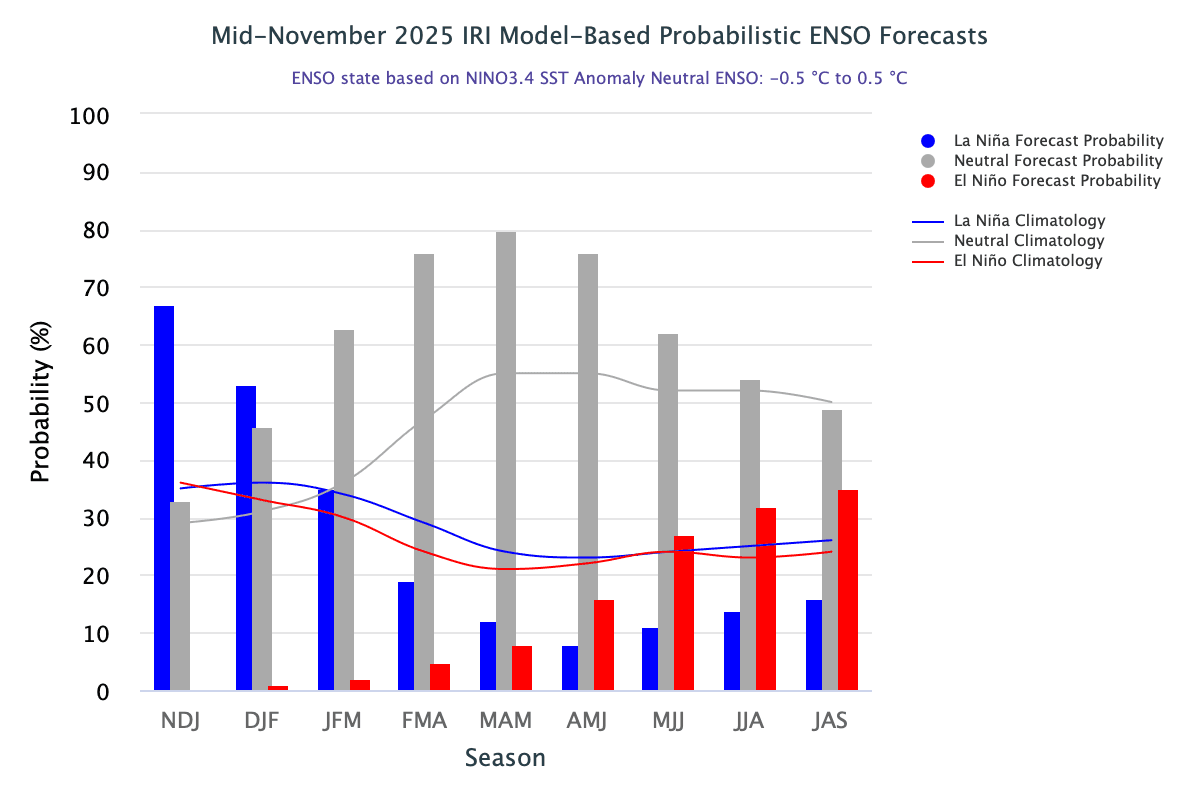
ENSO: Although ENSO predictability has improved with advanced understanding of ocean processes and dynamical forecasting, predicting its impacts remains a challenge because of large-scale internal atmospheric variability. Ongoing changes in the ENSO cycle underscore the need to emphatically address human-induced climatic changes impacting Pacific temperatures. Strategic research is required to continuously monitor any asymmetrical behaviour and reduce model biases for better understanding of the coupled phenomenon.
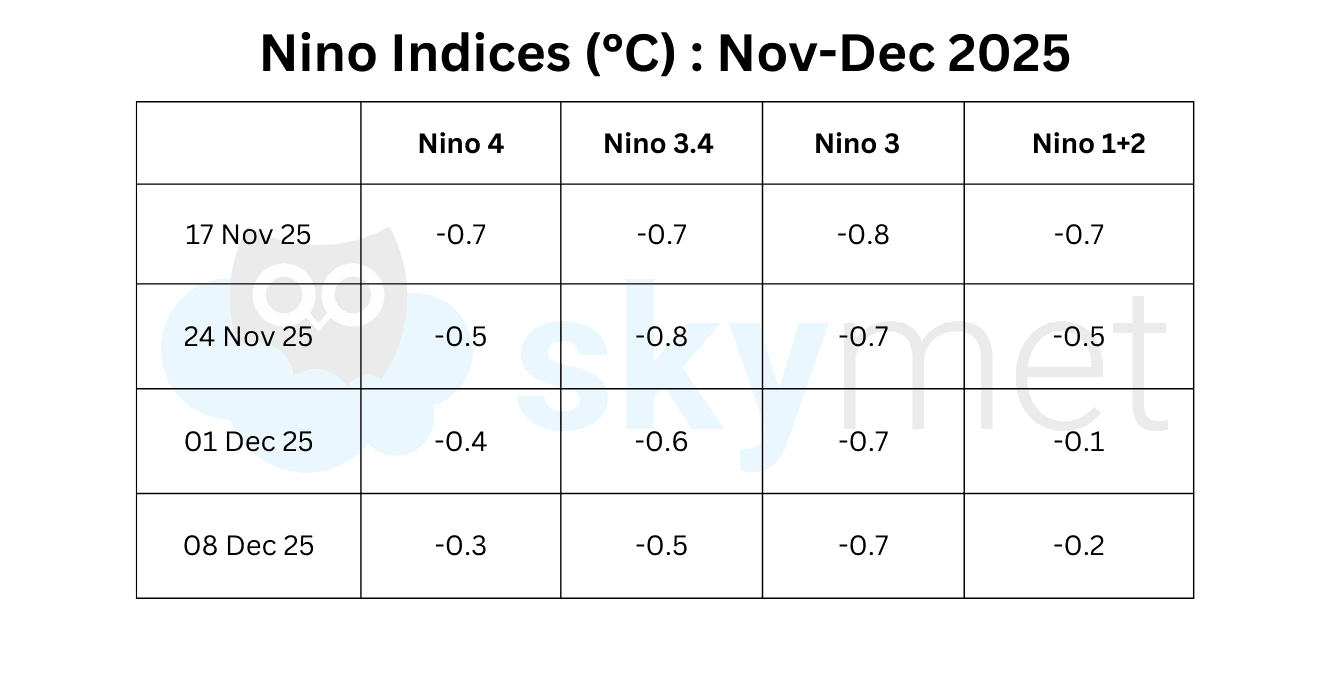
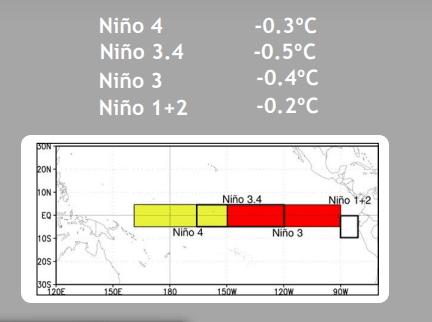
The quarterly ONI for Sep–Oct–Nov has crossed the threshold mark of La Niña (-0.5 °C). The ONI of -0.6 °C was last recorded in the quarter Dec–Jan–Feb 2025 during the previous La Niña episode. Yet, the Niño 3.4 index, the marker for the ONI, is dwindling. The weekly value has dropped to -0.5 °C from its earlier mark of -0.8 °C on 24 Nov 2025. The other Niño indices have also shown a tepid response, offering weak support towards La Niña build-up.
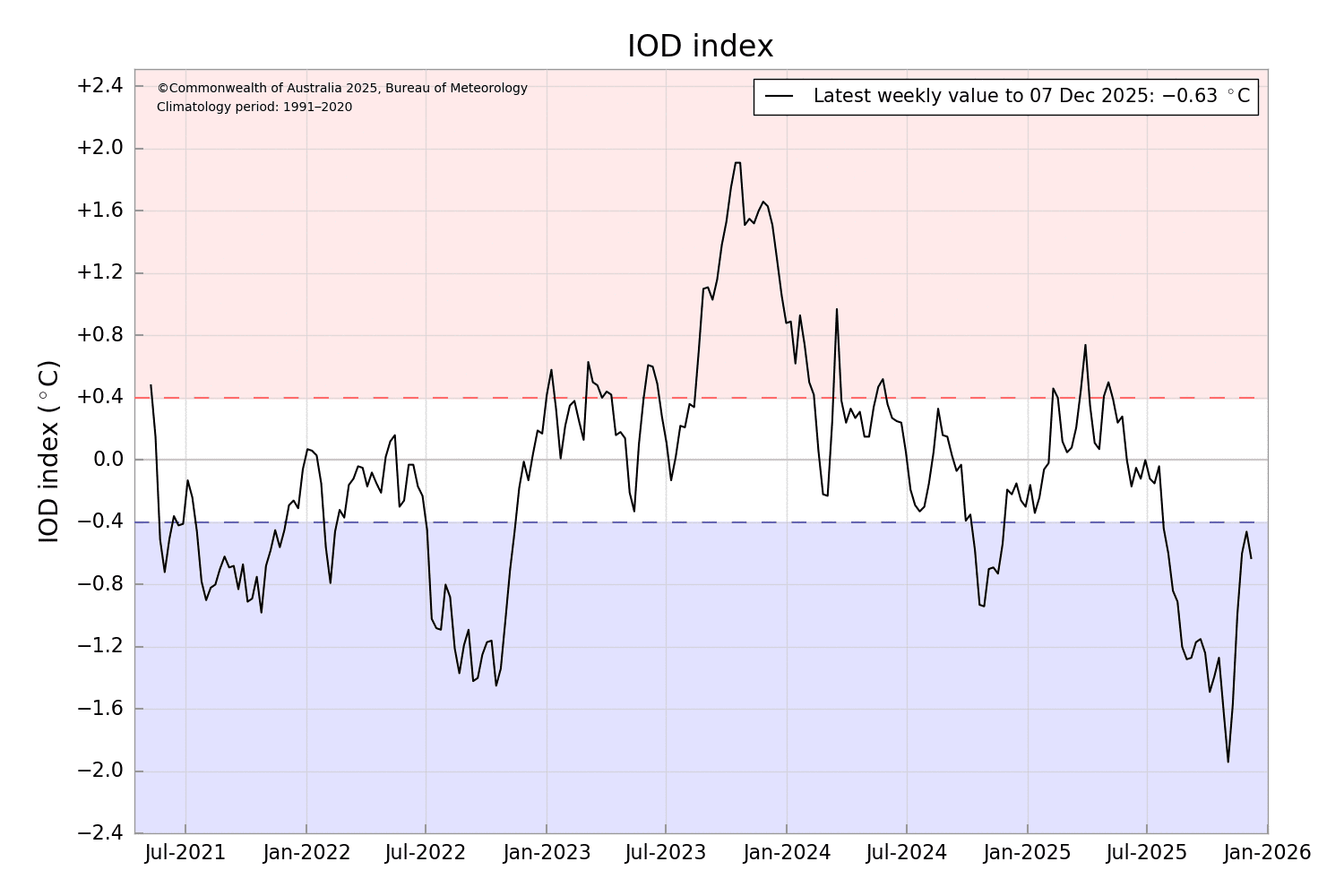
IOD: The Indian Ocean Dipole is an irregular oscillation of SSTs in which the western Indian Ocean becomes alternately warmer (positive phase) and colder (negative phase) than the eastern pool of the ocean. On average, four positive and four negative IOD events occur during each 30-year period, with each event lasting around six months. However, there were 12 positive IOD events between 1980 and 2009, and no negative IOD event between 1980 and 1992. This points towards a warmer-than-normal Arabian Sea compared to earlier decades.
Advertisement
The occurrence of consecutive positive IOD events is extremely rare, with only two such instances recorded: 1913–1914, and three consecutive events from 2006 to 2008. A positive IOD occurring alongside La Niña is also a rare phenomenon, having happened only once in available historical records, in 1967. The latest weekly IOD value as of 07 Dec 2025 was -0.63 °C, a drop of 0.2 °C from the earlier mark of -0.46 °C on 30 Nov 2025. The Bureau’s model predicts a return to neutral IOD conditions in December 2025, consistent with most international models and the typical IOD life cycle.
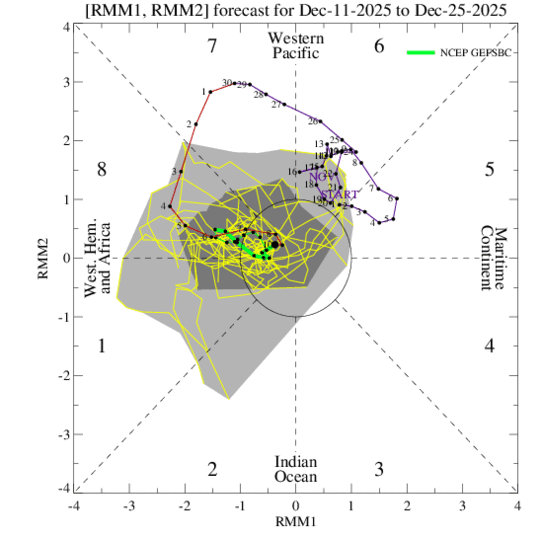
MJO: The Madden–Julian Oscillation was well organised over the western Pacific during the last two weeks, possibly leading to a weakening of the La Niña index during this period. The pulse has since propagated eastward and is currently located over the Western Hemisphere and Africa. The amplitude has diminished considerably and is expected to meander within the inner circle, remaining inconsequential for weather activity over the Indian Seas.

La Niña is taking baby steps, and the progress remains slow. As predicted, the event is likely to be brief and weak. However, under its influence, winter conditions over northern parts will remain under close watch and may get impacted, albeit slightly later in the season.