Mumbai Winters During La Nina Conditions: Below Normal Temperatures Likely


Image: AI-Skymet
Key Takeaways
- La Niña is expected to persist through winter 2025–26, influencing global and Indian winter weather.
- Mumbai generally remains insulated from extreme cold but can experience below-normal temperatures during La Niña years.
- December and January are the coldest months, with Santacruz recording sharper dips than Colaba.
- Winter temperatures in Mumbai may remain 2°–3°C below average, with fluctuations across suburbs.
Advertisement
La Niña conditions are expected to develop and are likely to continue through the Northern Hemisphere winter of 2025–26. A transition to ‘neutral’ conditions is expected during the spring season of 2026. La Niña has a major influence on winter weather across different parts of the world. It largely affects North America, Northern Europe, Alaska, Greenland and Scandinavian countries. Inclement weather systems travel towards Central Asia, the Western Himalayas, Afghanistan, North Pakistan and the northern mountains of India. Spells of extreme cold conditions sweep the plains of North India during the passage of active Western Disturbances. Snowfall in the mountains and rain-thundershowers in the plains trigger frigid weather conditions over these parts.
Advertisement
Anticyclonic winds over Central Rajasthan and West Madhya Pradesh are a seasonal feature during the winter months. This feature facilitates the flow of colder winds from the Northern Plains, Rajasthan and Madhya Pradesh towards Gujarat and the Maharashtra region. Though land-locked sub-divisions of Maharashtra, namely Madhya Maharashtra, Marathwada and Vidarbha, are more vulnerable to spells of cold waves, under favourable and specific conditions, the Konkan region also becomes susceptible to colder-than-normal conditions. Mumbai, being a coastal station, has a natural immunity from extreme cold conditions.
December and January are the coldest months for Mumbai. The mean monthly minimum temperature for Santacruz is 18.4°C in December and drops to 16.9°C in January. Since 2013, the capital city has recorded a low of 11.4°C in December (24 December 2015). A similar trend is seen during the month of January as well. As per normal distribution, the coastal city of Mumbai observes minimum temperatures of 19°–20°C on 5–6 days, 16°–18°C on about 20 days, and 13°–15°C on 4–6 days in each month during December and January.
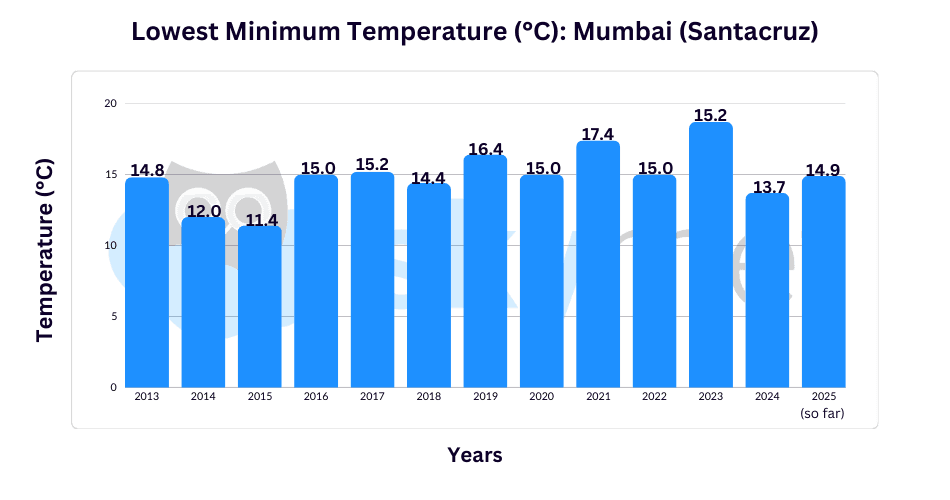
Beyond seasonal progression, the occurrence of El Niño and La Niña during the winter months influences Mumbai’s temperature profile. During La Niña years, Mumbai experiences colder-than-normal winter temperatures. Last year was a La Niña year, and the city recorded minimum temperatures of ≤15°C on five days, with the lowest being 13.7°C on 9 December 2024. Over the last decade, La Niña conditions were present in 2016, 2017, 2020 and 2022 during the winter season. In all these years, Mumbai plunged to the 15°C mark during December. A similar analogy applies to the month of January as well. There was, however, an outlier month of December 2015, when the mercury plummeted to 11.4°C (24 December) in a non-La Niña year.
Keeping the evolving La Niña conditions in view, Mumbai is likely to witness colder-than-normal winters, with temperatures dipping 2°–3°C below average. The ongoing spell of below-normal temperatures will ease from 13–14 December onwards. A rise of about 3°C is expected, with minimum temperatures climbing to 18°–19°C. The spatial distribution of temperatures across the city and suburbs remains highly erratic. Locations 15–20 km away from the coastline may record variations of 2°–3°C compared to Santacruz. The regional observatory at Colaba invariably records higher minimum temperatures than the airport observatory at Santacruz. Between 1 and 12 December 2025, the mean minimum temperature at Santacruz stood at 18.3°C, compared to 21.9°C at Colaba. Similar fluctuations are likely across other suburbs of the capital city.