Every El Nino Does Not Lead To Drought In India


Image: AI-Skymet
Key Takeaways:
- Pacific Ocean temperatures are rising rapidly, increasing the likelihood of a strong El Niño event in 2026.
- Climate models indicate El Niño conditions may officially emerge within weeks.
- Neutral IOD conditions and weakening MJO activity may still support monsoon progression over the Andaman Sea.
- A weather system over the Bay of Bengal could help advance monsoon onset slightly ahead of schedule.
The Pacific Ocean’s continued rapid warming towards El Nino has firmed up the odds against a poor Indian Monsoon. Equatorial sea surface temperatures (SSTs) are near-to-above-average in the central and eastern Pacific Ocean.

The analysis shows water temperatures have already risen more than 1°C since January in the Central Pacific, the greatest rate of warming this century and the most rapid transition from La Nina to ENSO-neutral and potential El Nino since 1976.

Forecasts continue to increase El Nino’s potential strength, which may shape up to be a very strong event. But then, stronger El Nino events do not necessarily lead to bigger droughts. The correlation between the strength and severity of impact is not robust. Even milder El Nino conditions during the monsoon months have triggered severe droughts, as in 2009.


El Nino severity is directly and positively correlated with surface temperature anomalies. NOAA classifies El Nino based on three-month mean SST anomalies in the Nino 3.4 region. In the Indian context, the seasonal rainfall has varied from ‘normal’ to ‘severe drought’ during El Nino years.

ENSO: El Nino has the potential to break records this season. The Nino 3.4 index, the most commonly used yardstick for the state of the Pacific, is now 0.4°C and could reach the CPC threshold of +0.5°C within weeks. But unless there is a clear positive response and evidence from the atmosphere getting unified with the ocean, the formal declaration remains in abeyance. However, climate models are strongly aligned, and there is high confidence in the onset of El Nino, followed by further intensification in the months that follow, say scientists at WMO.

Sea surface temperatures are rising rapidly, pointing to a likely return of El Nino conditions as early as the May-July quarter. All four Nino indices in the central and eastern equatorial Pacific Ocean are near the threshold of +0.5°C. The atmospheric arm is also aligned with the ocean temperature profile.

The Southern Oscillation Index (SOI) is a standardized mark based on the observed sea level pressure (SLP) difference between Tahiti and Darwin, Australia. The SOI is one measure of the large-scale fluctuation in air pressure occurring between the western and eastern tropical Pacific during El Nino and La Nina episodes. The negative phase of the SOI represents below-normal air pressure at Tahiti and above-normal air pressure at Darwin. Prolonged periods of negative SOI values coincide with abnormally warm ocean waters across the eastern tropical Pacific, typical of an El Nino episode. The average SOI for the month of April is -0.6. It has turned negative for the first time since October 2024, after the cessation of the El Nino episode of 2023-24.


IOD: The Indian Ocean Dipole value has remained close to the zero mark for the last seven weeks. The index value for the week ending May 3, 2026, was +0.01°C. The IOD is considered inactive when the DMI lies between -0.4°C and +0.4°C. Traditionally, El Nino events are accompanied by neutral or positive IOD, and conversely, La Nina events are escorted by negative IOD.

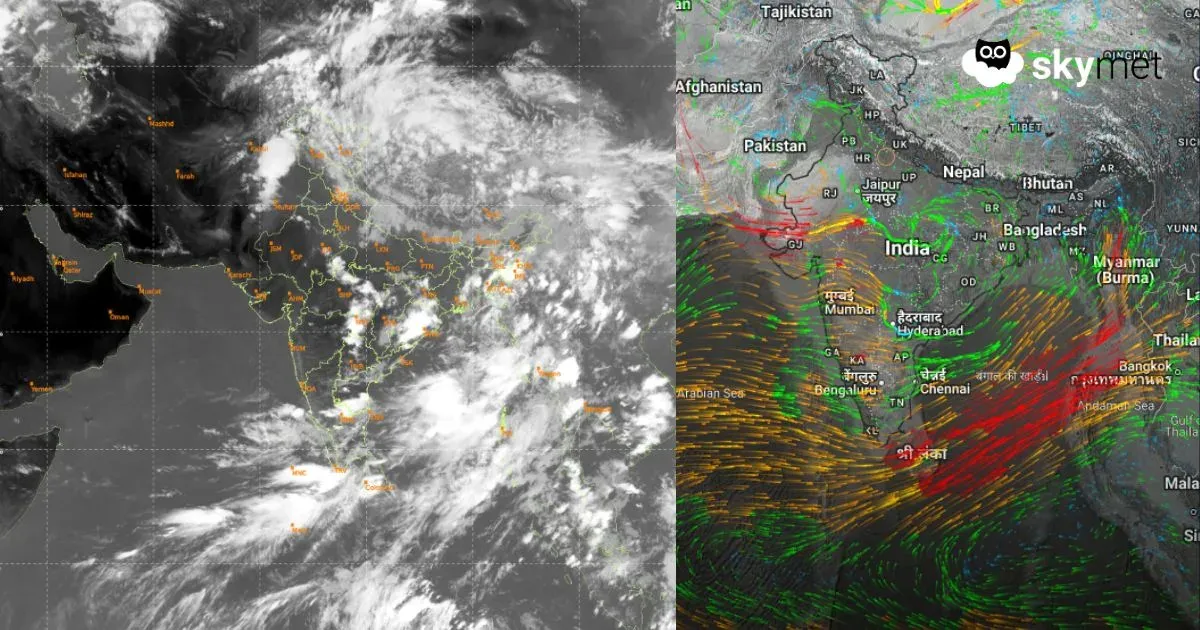
MJO: An organized MJO propagated from the Western Hemisphere to the Indian Ocean, but the MJO activity has recently been suppressed by destructive interference with other modes of tropical variability. The weakened phase of the MJO is expected to inhibit tropical cyclone development over the Pacific Ocean. It is likely to meander within the inner circle over the Indian Ocean and Maritime Continent. It may push some support to build equatorial flow over the southeastern parts of the Indian Ocean and adjoining Bay of Bengal.
The monsoon onset phase is getting closer for the Andaman Sea. Though there is no strong cross-equatorial flow over the Bay of Bengal branch as of now, there is a likelihood of a weather system coming up over the South and Southwest Bay of Bengal. This may assist the progress of the monsoon stream over the Andaman Sea and potentially over the mainland, maybe a little before time.