Dry Weather Conditions Over Delhi: No Sharp Drop Of Temperatures Likely

Key Takeaways
- Minimum temperatures remain in double digits in Delhi, with only a brief dip to single digits expected early next week.
- November continues its reputation as the driest month, and 2025 is likely to register zero rainfall, joining past “barren” years.
- No active weather systems are present over the mountains or plains, keeping conditions stable and dry.
- A Bay of Bengal system may briefly alter wind patterns mid-month, raising temperatures again, but no cold wave is expected for Delhi/NCR in November 2025.
As expected, the minimum temperature for Delhi has increased to double digits for the second consecutive day. Base station Safdarjung recorded a minimum of 11.4°C, a rise of 1.2°C from the previous day. Mercury is expected to stay in double digits for the next three days. No rainfall is likely in the remaining days of November.
Advertisement
[Check your local weather forecast here]
Advertisement
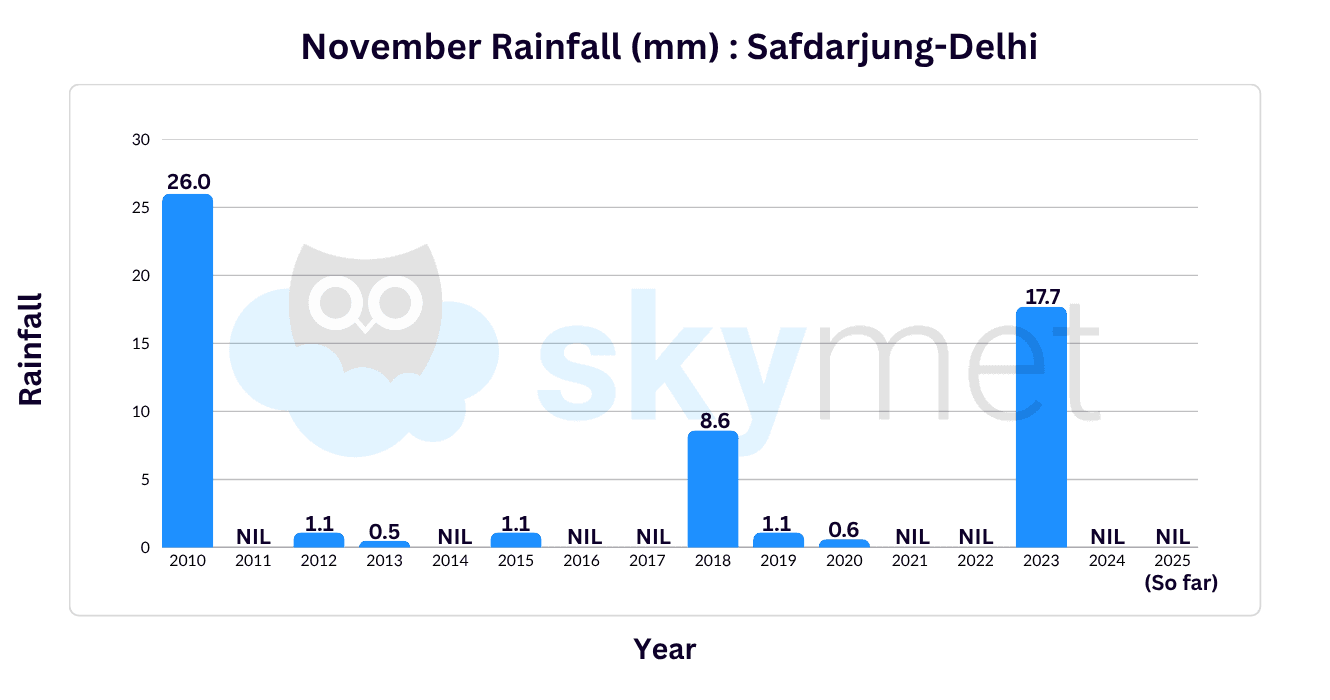
November, as such, is the least rainy month with an average of 4.1 mm rainfall. Out of the last ten years, since 2015, Delhi did not see any rainfall in five of these years during November. The highest rainfall during this period was 17.7 mm, recorded in November 2023. The average rainfall of November between 2015 and 2024 was 2.9 mm. Since 2011, double-digit rainfall in November was recorded only once, in 2023. November 2025 is likely to join the club of “barren” months with nil rainfall through the month.
There is no likelihood of any active weather system, either over the mountains or the plains, during this month. Accordingly, dry weather conditions are expected in the remaining days of the month. Even for temperatures, a seasonal progressive fall can be expected, without any sharp dip till the end of the month. The mercury may slip into single digits briefly between the weekend and early next week. A strong weather system is likely to come up over the Bay of Bengal by this weekend and intensify further by mid-next week. The wind pattern over the central parts of the country, extending up to the Delhi region, will be governed by the movement of this system. In all probability, a reversal of winds is likely over Delhi, from westerly to easterly, at least in the lower levels, around the middle of next week. Temperatures are likely to rise again during that period and may stay elevated till the end of the month. No cold wave conditions are likely for Delhi/NCR during November 2025.
METHODOLOGY
This assessment is developed using continuous monitoring of real-time and historical meteorological data, ground observations, radar scans, satellite imagery, numerical models, and long-term climatology.
Forecast Interpretation Framework
The forecast interpretation relies on synoptic chart analysis to assess the presence or absence of western disturbances, cyclonic circulations, and plains-level features. Numerical Weather Prediction (NWP) model outputs, including ECMWF, GFS, and Skymet’s in-house ensemble models, are evaluated alongside wind-field behaviour and evolving atmospheric signals to understand system development and temperature trends.
Numerical Weather Models
Forecasts are validated against a suite of global and regional models, including:
• Global models: GFS, ECMWF, UKMET, ICON
Advertisement
• High-resolution regional models: WRF, HARMONIE-AROME, and proprietary AI-based ensemble systems
Key diagnostic fields analysed include pressure patterns, vorticity, humidity layers, vertical velocity, wind shear, stability indices (CAPE–CIN), and ensemble spreads to evaluate model consistency and forecast reliability.
Cross-Verification & Expert Insight
Model guidance is cross-checked with real-time radar and satellite behaviour, supported by climatological trends, field reports, and historical pattern recognition. This ensures that forecasts reflect both observational truth and real-time atmospheric evolution.