Delhi Air Quality Worsens Sharply in October; Dharuhera Tops List of India’s Most Polluted Cities

Courtesy: CREA
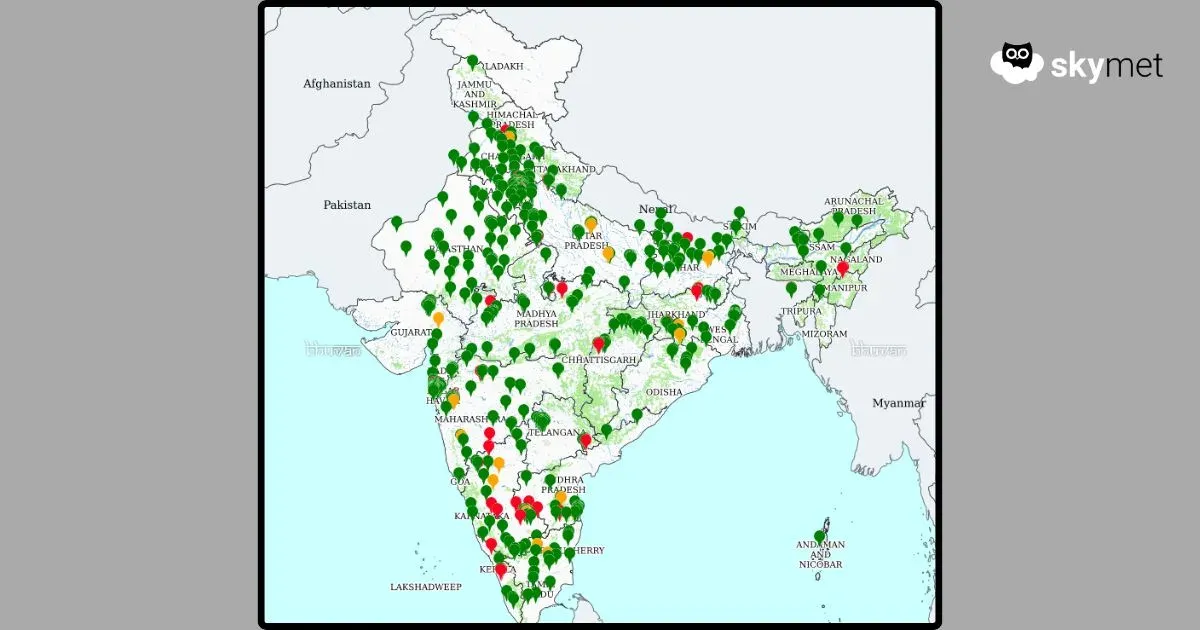
India’s air quality saw a significant decline in October 2025, with the number of cities recording elevated PM₂.₅ levels rising sharply, according to the latest analysis by the Centre for Research on Energy and Clean Air (CREA).
Most Cities Breach WHO Standards
Out of 249 cities monitored, 212 had more than 80% data availability from continuous ambient air quality monitoring stations (CAAQMS). Among these, 243 cities exceeded the World Health Organization’s (WHO) safe daily guideline of 15 µg/m³ — a jump from 203 cities in September.
Advertisement
Advertisement
Courtesy: CREA
However, 86 of the 98 National Clean Air Programme (NCAP) cities managed to stay within India’s national standards for daily PM₂.₅ concentration, which is set at 60 µg/m³ under the National Ambient Air Quality Standards (NAAQS). Similarly, 126 of the 151 non-NCAP cities also met this benchmark.
Only six cities nationwide complied with the WHO’s stricter air-quality guidelines in October.
Nationwide Shift to Poorer Air Quality
The air quality index (AQI) distribution changed notably over the month. Cities in the ‘Good’ category (0–30 µg/m³) dropped to 68 in October from 179 in September. Those under ‘Satisfactory’ (31–60 µg/m³) rose to 144, while the number of ‘Moderate’ cities (61–90 µg/m³) shot up to 27 from just four in September.
Nine cities entered the ‘Poor’ (91–120 µg/m³) category, and one city fell into the ‘Very Poor’ (121–250 µg/m³) range. This widespread shift was especially notable across the Indo-Gangetic Plain, including the National Capital Region (NCR).
Dharuhera Emerges as India’s Most Polluted City
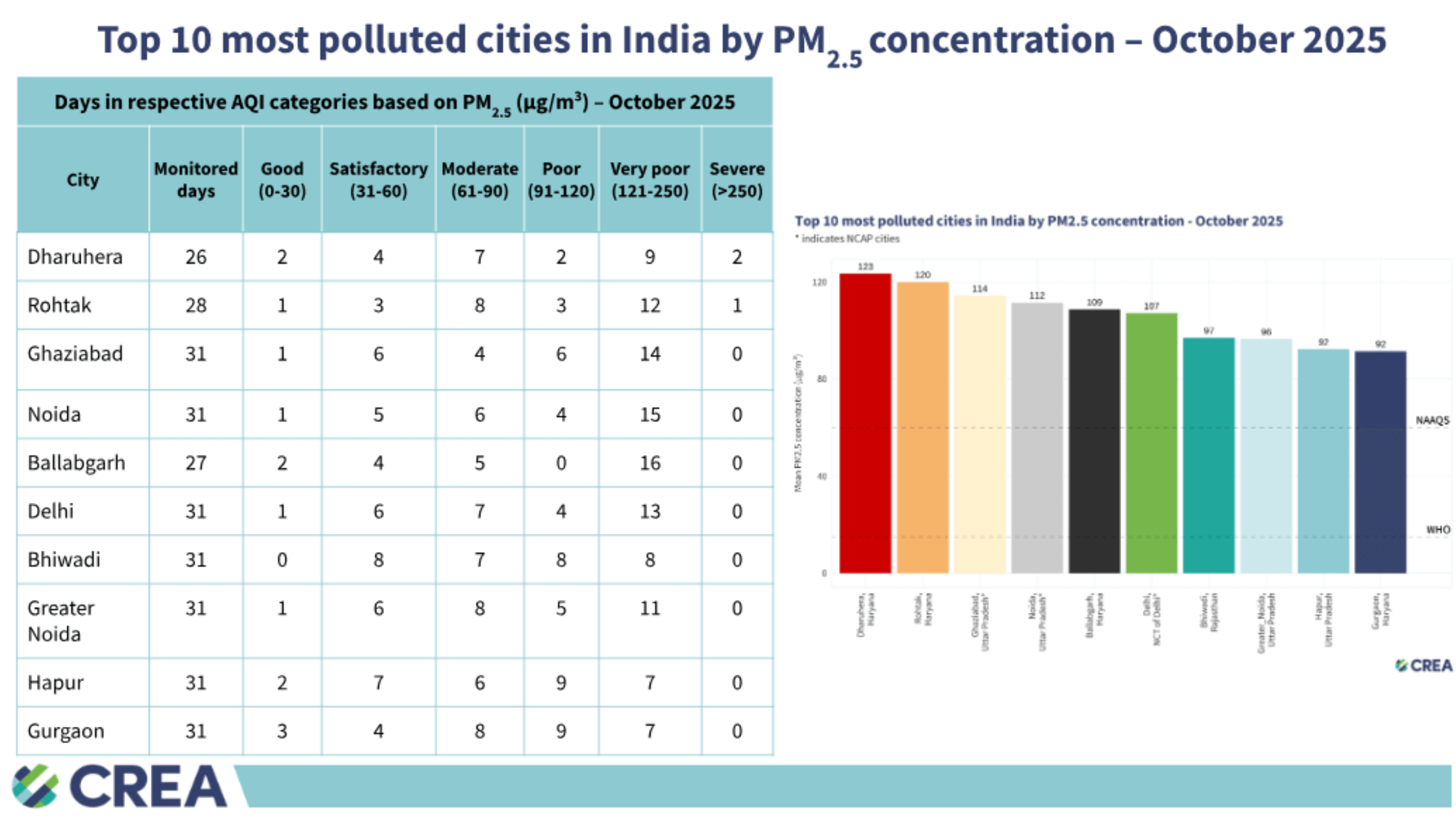
Dharuhera in Haryana ranked as the most polluted city in India for October 2025, with a monthly average PM₂.₅ concentration of 123 µg/m³. The city exceeded the daily NAAQS limit 77% of the days in the month.
It recorded two days of ‘Good’ air quality, four ‘Satisfactory’, seven ‘Moderate’, two ‘Poor’, nine ‘Very Poor’, and two ‘Severe’ days.
Rohtak, Ghaziabad, Noida, Ballabhgarh, Delhi, Bhiwadi, Greater Noida, Hapur, and Gurgaon rounded out the top ten most polluted cities—all within the NCR.
Delhi itself ranked sixth, posting an average PM₂.₅ level of 107 µg/m³, nearly three times higher than its September average of 36 µg/m³. Despite stubble burning contributing less than 6% to Delhi’s pollution in October, sustained high levels indicate ongoing emissions from multiple sources. CREA’s analysis underscores the need for a comprehensive, long-term strategy beyond the short-term winter plans typically deployed.
Advertisement
Cleanest Cities Offer a Contrast
At the other end of the spectrum, Shillong, Meghalaya, recorded the cleanest air in the country with a monthly average PM₂.₅ of just 10 µg/m³.
The ten cleanest cities included four from Karnataka, three from Tamil Nadu, and one each from Meghalaya, Sikkim, and Chhattisgarh. Among India’s megacities, Chennai, Mumbai, Kolkata, and Bangalore stayed within the NAAQS limits, with Delhi being the only exception.
Most Cities Have Already Overshot WHO Limits
The CREA report also tracked “overshoot days” — points in the year after which even extremely low remaining pollution levels would still mean annual standards are breached.
By October 2025, 255 out of 293 cities had already overshot the WHO’s annual PM₂.₅ standard, showing widespread non-compliance across the country. In contrast, only 37 cities had overshot India’s more lenient NAAQS limit.
This stark difference reveals that India’s current air-quality standards are lagging behind global benchmarks. The NAAQS, last revised in 2009, are now considered outdated. CREA highlights the urgent need for revision to align national targets with the WHO’s latest interim goals for better public health protection.
Note: Data and rankings are sourced from the Centre for Research on Energy and Clean Air (CREA), based on continuous ambient air quality monitoring (CAAQMS) data from the Central Pollution Control Board (CPCB) for October 2025.
Trending: ISRO Makes History: ‘Bahubali’ LVM3 Rocket Powers India’s Heaviest Satellite CMS-03 into Orbit
Delhi Weather: Sharp Drop In Mercury- Dry Weather Continue