

Pair Of Tropical Storms In Atlantic: Rare Fujiwhara Effect Likely


Image Courtesy: CIMSS
After a long pause, the Atlantic Ocean has become an active basin for storms and hurricanes. Earlier, Hurricane Gabrielle in the West Atlantic skirted the US East Coast and barreled towards Europe. Close on its heels, another tropical storm, Humberto, formed a little away from the Caribbean countries and is likely to become a hurricane soon. Alongside Humberto, there is an ‘Invest Area’ 94 L, a potential tropical storm sometime on the weekend. These two storms are drawing closer in the Atlantic, raising the possibility of a rare Fujiwhara Effect.
Advertisement
Fujiwhara Effect is a very complex dynamic where two cyclonic storms or hurricanes, spinning in the same direction, get placed within 900 miles of each other. The case in point here is the tropical storm Humberto, a potential hurricane, and another tropical storm, Imelda, in the making over the Atlantic Ocean. Although the environmental conditions will vary for the two systems because Imelda will be in close proximity to the landmass of the Caribbean and Humberto will be in the open waters, at least for the next four days. The Fujiwhara Effect is meteorology’s rarest and most intriguing phenomenon wherein two storms in close proximity begin to orbit a shared central point, creating a “dancing” motion. Each of these storms starts circulating around the midpoint, spinning in a synchronized pattern.
Advertisement
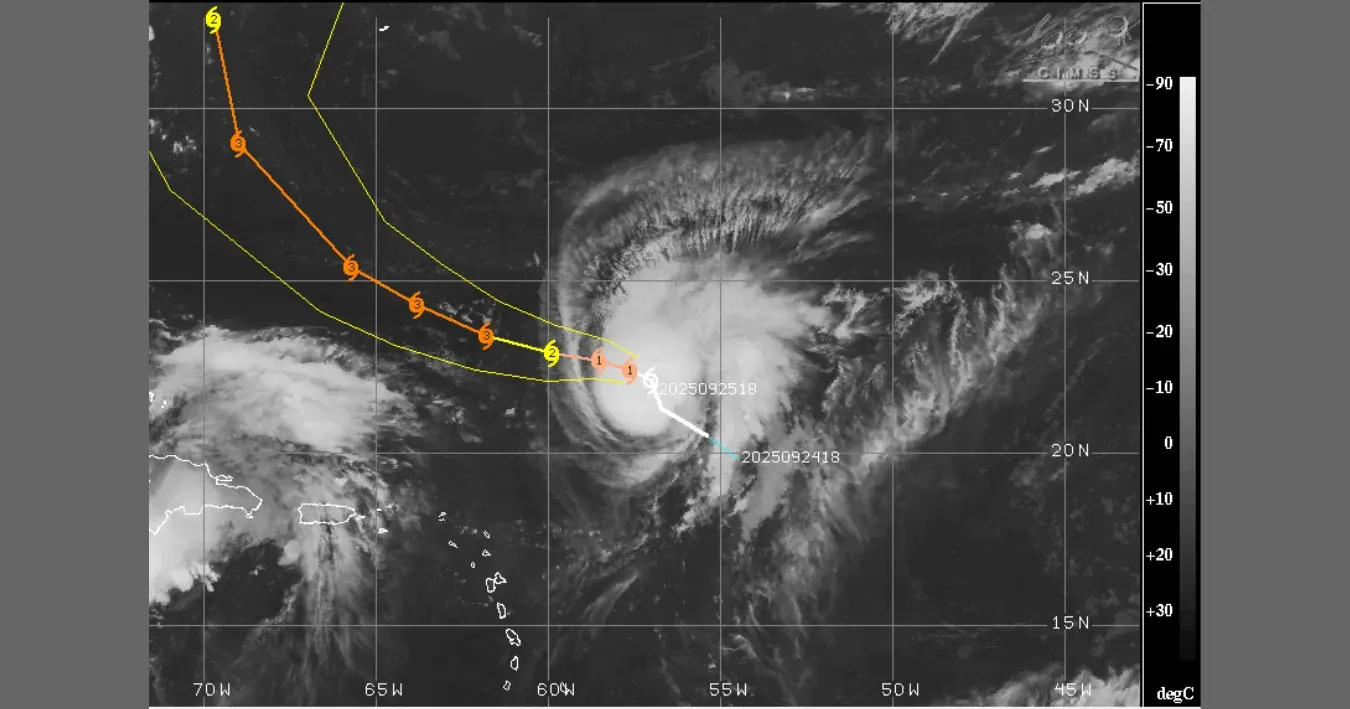
Typically, during the process of rotation, the stronger storm dominates, pulling the weaker system into its circulation, potentially absorbing it entirely. In rare cases, storms of equal strength can get subsumed to make one powerful cyclone. In such cases, the standard models may struggle to accurately predict the track, intensity, and timeline, including landfall, if any. The rare occurrence in the Atlantic adds another dimension to the unpredictability of the hurricane season.
Sakuhei Fujiwhara, a Japanese meteorologist, studied the interaction of vortices placed in close vicinity over water and their implications on atmospheric dynamics. The Fujiwhara Effect is more commonly observed in the Western Pacific due to the higher frequency of cyclones forming in close proximity. Closely placed cyclones are less frequent in the Atlantic and therefore need more attention for their likely behavior. The last recorded Atlantic Fujiwhara event took place in September 2023, when tropical storms Philippe and Rina observed a complex orbital pattern, albeit briefly. Sometimes, two powerful storms do come up in the Indian Ocean, one each on either side of the equator and more or less having longitudinal alignment. However, these storms may not be spinning in the same direction because of opposite rotation in the two hemispheres.


